

The Christmas Story as Creative Calling: Receiving the Gift of Your Design
In the Beginning Was the Word
“In the beginning was the Word, and the Word was with God, and the Word was God. He was with God in the beginning. Through Him all things were made; without Him nothing was made that has been made... The Word became flesh and made His dwelling among us. We have seen His glory, the glory of the one and only Son, who came from the Father, full of grace and truth.” (John 1:1-3, 14)
God is a Creator. This is perhaps the first and most fundamental truth we know about Him. Before He is Redeemer, before He is King, before any other title or attribute—He is a Creator. The opening words of Scripture introduce us to a God who speaks worlds into existence, who breathes life into dust, and who forms and fashions with intentionality and care.
And when this Creator God chose to reveal Himself most fully to humanity, He chose the most creative act possible: incarnation. The Word became flesh. God didn’t just tell us about Himself through prophets or write about Himself in scrolls. He showed us. He took on a body, entered time and space, and became tangible and touchable. He chose the creative medium of humanity itself.
This matters more than we often realize. It means that physical, embodied, creative expression is validated at the highest level. It means that being made in the image of this Creator isn’t just theological language—it’s an invitation into creative partnership with God Himself.
I’ve found that accepting my own creative design—my specific personality, my particular calling, my unique way of seeing and expressing truth—has drawn me closer to Jesus in unexpected ways. Because when I see myself as an image-bearer of the ultimate Creator, my creativity isn’t just a hobby or a career. It’s a tangible connection to the One who made me.
But this creative act of incarnation didn’t happen in a vacuum. It had a story. And that story, the one we celebrate every Christmas, teaches us profound truths about our own creative calling.
The Annunciation: Receiving the Call
“In the sixth month of Elizabeth’s pregnancy, God sent the angel Gabriel to Nazareth, a town in Galilee, to a virgin pledged to be married to a man named Joseph, a descendant of David. The virgin’s name was Mary. The angel went to her and said, ‘Greetings, you who are highly favored! The Lord is with you.’
Mary was greatly troubled at his words and wondered what kind of greeting this might be. But the angel said to her, ‘Do not be afraid, Mary; you have found favor with God. You will conceive and give birth to a son, and you are to call him Jesus....’
‘I am the Lord’s servant,’ Mary answered. ‘May your word to me be fulfilled.’” (Luke 1:26-31, 38)
Mary didn’t create her calling. She received it.
This distinction is crucial for understanding our own creative design. Mary didn’t wake up one morning and decide she wanted to be the mother of the Messiah. She didn’t work toward this goal, didn’t craft a strategic plan, didn’t hustle her way into God’s favor. The calling came to her—unexpected, uninvited, unfathomable.
And her response? “Let it be to me according to your word.”
Not “let me figure out how to make this happen.” Not “let me control every aspect of this journey.” Simply: let it be—a posture of surrender, of reception, and of trust.
This is so counter to how we often approach our creative calling. We want to manufacture it, control it, and shape it to our preferences. We look at our DISC personality profile and wish we were a different type. We look at our season of life and resent the constraints. We look at our gifts and compare them to others’, finding ours lacking.
But what if, like Mary, we’re called to receive rather than create our design?
Different personality types struggle with different aspects of this surrender. D-types want to be in control of the design itself—”Why did You make me this way, God? I would have chosen differently.” I-types fear the solitary, focused work that creativity sometimes requires—”But I need people! I need connection!” S-types resist the visibility and change that creative calling often brings—”Can’t I just support others from the background?” C-types struggle with the imperfection inherent in the creative process—”But it’s not excellent yet. It’s not ready.”
Mary’s example gives us permission: Acceptance doesn’t mean understanding. It doesn’t mean we see the full picture. It doesn’t mean we feel ready or qualified or equipped. It simply means we say yes to what God has already designed.
“For the gifts and the calling of God are irrevocable.” (Romans 11:29 ESV)
Your creative design—your personality, your passions, your particular way of seeing and expressing truth—isn’t random. It’s a gift. And like Mary, we’re invited to receive it with open hands.
But receiving the call was only the beginning. Mary would soon discover that creative calling comes with constraints.
The Journey to Bethlehem: Creative Constraints
“In those days Caesar Augustus issued a decree that a census should be taken of the entire Roman world... And everyone went to their own town to register.
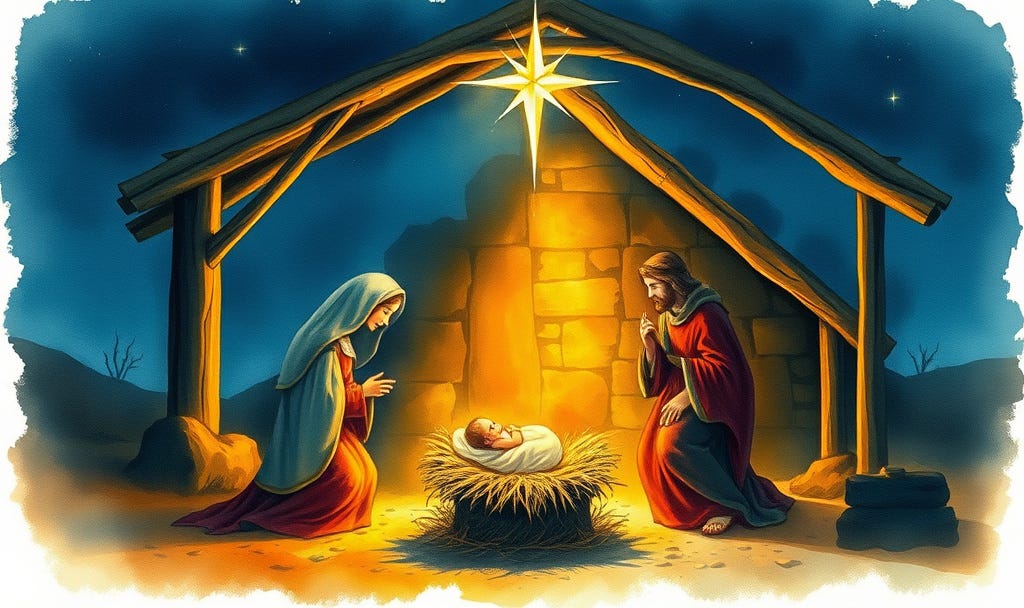
So Joseph also went up from the town of Nazareth in Galilee to Judea, to Bethlehem, the town of David, because he belonged to the house and line of David. He went there to register with Mary, who was pledged to be married to him and was expecting a child. While they were there, the time came for the baby to be born, and she gave birth to her firstborn, a son. She wrapped him in cloths and placed him in a manger, because there was no guest room available for them.” (Luke 2:1-7)
Think about the timing. Mary is nine months pregnant. Full-term. Any day now. And suddenly: mandatory travel. A journey of roughly 90 miles from Nazareth to Bethlehem. On foot or donkey. While in labor or on the verge of it.
This wasn’t part of the plan. This wasn’t convenient. This wasn’t ideal circumstances for bringing the Savior of the world into existence.
And then: no room at the inn. The most vulnerable moment imaginable—about to give birth—and there’s no space. No comfort. No ideal setting. Just a stable, a feeding trough, the smell of animals and hay.
We might expect the incarnation of God to come with fanfare, with perfect conditions, with all the right resources in place. Instead, it came with constraints. Real, tangible, uncomfortable constraints.
Here’s what stuns me: These constraints weren’t obstacles to God’s plan. They were part of it.
The manger wasn’t plan B. The stable wasn’t an unfortunate circumstance God had to work around. The census, the journey, the “no room”—all of it was woven into the story God was telling. Jesus was born into constraints, not despite them.
This changes everything about how we view our own creative constraints.
We look at our DISC personality and see limitations. D-types chafe at needing collaboration and input from others. I-types struggle with the need for focused, deep work away from people. S-types resist the change and risk that creative calling requires. C-types feel trapped by imperfect circumstances that never quite meet their standards.
We look at our season of life and see obstacles. I think of my own life—three young boys, stay-at-home mom, single-income household, ministry commitments, the beautiful chaos of this stage. Some days I wonder if I should just wait for a “better season” to pursue creative work. When the kids are older. When there’s more margin. When circumstances are more ideal.
But what if, like the manger, my constraints aren’t limitations to my calling? What if they are the form my calling takes right now?
“But He said to me, ‘My grace is sufficient for you, for My power is made perfect in weakness.’ Therefore I will boast all the more gladly about my weaknesses, so that Christ’s power may rest on me.” (2 Corinthians 12:9)
The manger teaches us that God specializes in working within constraints. Your personality isn’t a limitation—it’s your particular lens for seeing and expressing truth. Your season isn’t an obstacle—it’s the context that shapes your creative work in unique ways. Your resources, your energy levels, your responsibilities—these aren’t barriers to overcome before you can finally create. They’re the parameters within which God has called you to create right now.
Jesus entered the world in the most constrained circumstances imaginable. Yet that constrained beginning was exactly right for the story God was telling.
Your constraints are part of your story too.
The Shepherds: Creative Expression as Worship
“And there were shepherds living out in the fields nearby, keeping watch over their flocks at night. An angel of the Lord appeared to them, and the glory of the Lord shone around them, and they were terrified. But the angel said to them, ‘Do not be afraid. I bring you good news that will cause great joy for all the people. Today in the town of David, a Savior has been born to you; He is the Messiah, the Lord. This will be a sign to you: You will find a baby wrapped in cloths and lying in a manger.’
Suddenly, a great company of the heavenly host appeared with the angel, praising God and saying, ‘Glory to God in the highest heaven, and on earth peace to those on whom His favor rests.’
When the angels had left them and gone into heaven, the shepherds said to one another, ‘Let’s go to Bethlehem and see this thing that has happened, which the Lord has told us about.’
So they hurried off and found Mary and Joseph, and the baby, who was lying in the manger. When they had seen him, they spread the word concerning what had been told them about this child, and all who heard it were amazed at what the shepherds said to them... The shepherds returned, glorifying and praising God for all the things they had heard and seen, which were just as they had been told.” (Luke 2:8-18, 20)
The shepherds couldn’t keep silent.
This is crucial to understand: They weren’t commanded to go tell everyone. They weren’t given marching orders to spread the news. They simply encountered Christ, and expression became inevitable.
“When they had seen him, they spread the word.” It wasn’t an obligation. It was an overflow.
This is what happens when we truly receive the gift of Christ and the gift of our creative design: We can’t help but express it. Not from duty or pressure or comparison or platform-building strategy. From wonder. From worship. From the natural overflow of encountering something so beautiful, you have to share it.
“Each of you should use whatever gift you have received to serve others, as faithful stewards of God’s grace in its various forms. If anyone speaks, they should do so as one who speaks the very words of God. If anyone serves, they should do so with the strength God provides, so that in all things God may be praised through Jesus Christ.” (1 Peter 4:10-11)
Notice how the shepherds’ expression happened: They “hurried off” and found Jesus. Then they “spread the word” about what they’d seen. Then they “returned, glorifying and praising God.”
Movement. Expression. Return. Worship.
And notice what Luke tells us about Mary during all this commotion: “But Mary treasured up all these things and pondered them in her heart.” (Luke 2:19)
Both responses are valid. Both are needed. The shepherds’ immediate, exuberant sharing. Mary’s quiet, reflective pondering. Different personalities, different expressions, same encounter with Christ.
This is where our DISC design becomes beautiful rather than limiting. We don’t all express our creative calling the same way—and we’re not meant to.
D-types build and lead, creating structures and systems that serve others. I-types inspire and connect, drawing people together through story and relationship. S-types support and sustain, providing the steady presence that allows others to flourish. C-types craft with excellence, attending to details that create beauty and truth.
We are all image-bearers. We are all creatives. But we express it as uniquely as the shepherds and Mary expressed their encounter with Christ.
The key is this: Creative expression becomes worship when it flows from receiving rather than striving. When it’s an overflow rather than an obligation. When it points not to ourselves but to the One who designed us.
“In the same way, let your light shine before others, that they may see your good deeds and glorify your Father in heaven.” (Matthew 5:16)
Your creative work—whether it’s writing or teaching, building or connecting, supporting or crafting—is meant to point others toward the Creator. Not because you’ve manufactured something impressive, but because you’ve received the gift of your design and are stewarding it faithfully.
The Gift Received, The Gift Given
“The Son is the image of the invisible God, the firstborn over all creation. For in Him all things were created: things in heaven and on earth, visible and invisible, whether thrones or powers or rulers or authorities; all things have been created through Him and for Him. He is before all things, and in Him all things hold together.” (Colossians 1:15-17)
We return to where we began: Christ as Creator.
But now we see Him also as the created—the Word made flesh, the invisible God made visible, the Creator entering His own creation. The incarnation is both God’s creative self-expression and the greatest creative gift ever given.
And here’s the stunning truth: Our creative design is part of receiving the gift of Christ.
When we accept that we are made in the image of the Creator God—when we stop fighting our DISC personality and start stewarding it, when we stop resenting our constraints and start creating within them, when we stop comparing our expression to others’ and start offering our unique worship—we are receiving the gift of who God made us to be.
This is deeply personal for me. For years, I tried to be a different kind of creative. More extroverted. More linear. More conventional. I looked at my multi-passionate nature, my need for both depth and variety, my season of full-time motherhood, and saw obstacles.
But accepting my creative design—all of it, constraints and quirks and particular personality included—has become an act of worship. It’s how I receive the gift of Christ more fully. Because when I see myself as an image-bearer of the ultimate Creator, when I embrace rather than fight the way He designed me, I’m saying yes to His artistry. I’m trusting His design. I’m receiving His gift.
Just as Mary said, “Let it be to me according to your word.”
Just as the shepherds couldn’t keep silent after encountering Christ.
Just as Jesus Himself entered the constraints of human existence to reveal the Father.
A Christmas Invitation
This Christmas Eve, as you prepare to celebrate the incarnation, consider this:
The same God who spoke worlds into existence designed you. Specifically. Intentionally. Your personality isn’t an accident. Your creative bent isn’t random. Your particular way of seeing and expressing truth isn’t a limitation—it’s your lens.
Receiving the gift of Christ means receiving the gift of your creative design. All of it. The parts you love and the parts you wish you could change. The season you’re in and the constraints you’re living with. The unique expression that flows from your particular encounter with the Creator.
You don’t have to create your calling. You don’t have to manufacture your design. You don’t have to become someone else to be a faithful steward of your gifts.
You simply have to receive.
Let it be. Like Mary.
Then let it overflow. Like the shepherds.
All within the beautiful constraints of the life God has given you. Like Jesus in the manger.
“For the gifts and the calling of God are irrevocable.” (Romans 11:29 ESV)
Your creative design is God’s gift to you. How you steward it is your gift back to Him.
Merry Christmas.
Connect & Support
🌱 Join Our Community: Subscribe to receive The Sunday Sabbath newsletter and follow along on this soft, sacred, slow journey.
🤍 Support This Ministry:
Monthly Support: Join the Cultivator’s Circle to sustain this digital ministry with a monthly contribution.
One-Time Gift: Prefer a one-time donation? You can nurture this garden with a single contribution.
📚 Explore Resources: Discover books, assessments, and resources to support your creative journey in the Salty Page Books shop.
💬 Share Your Thoughts: I’d love to hear your perspective in the comments below.